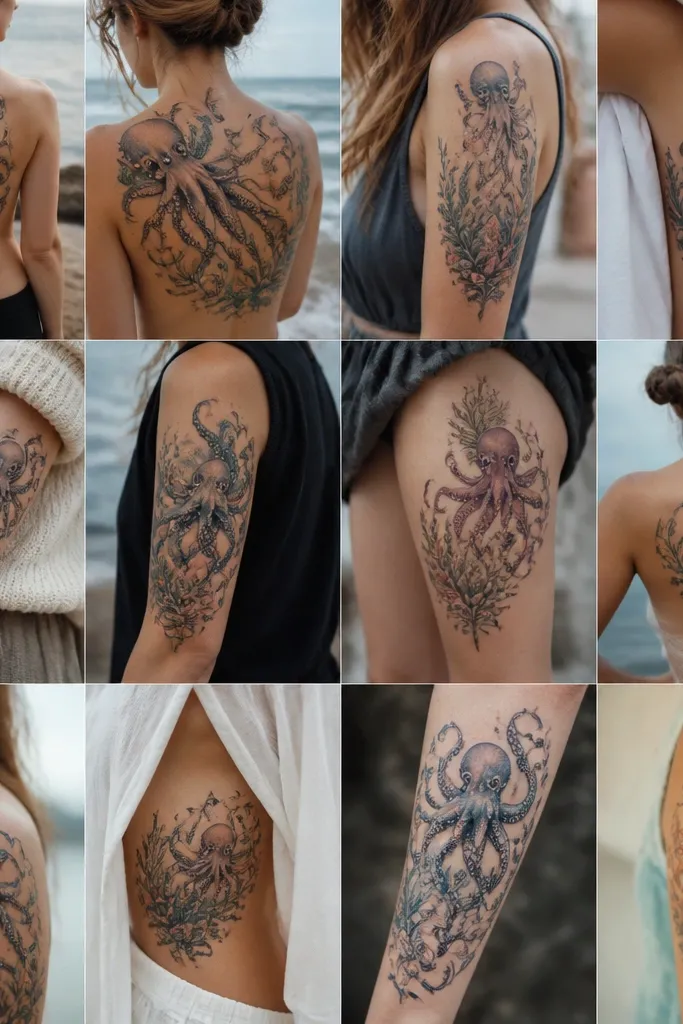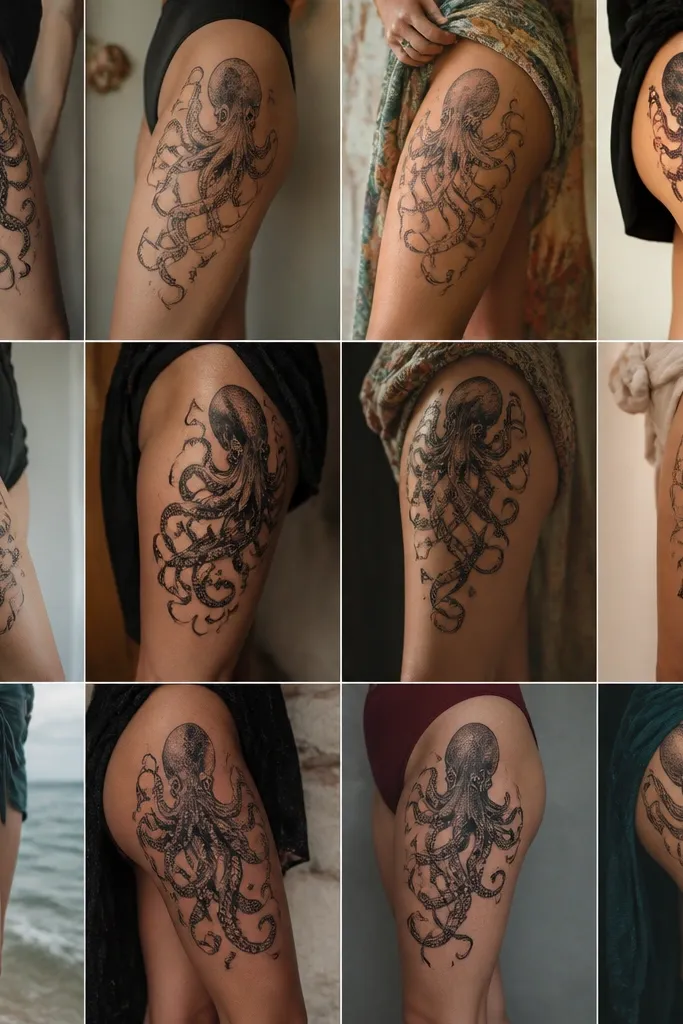
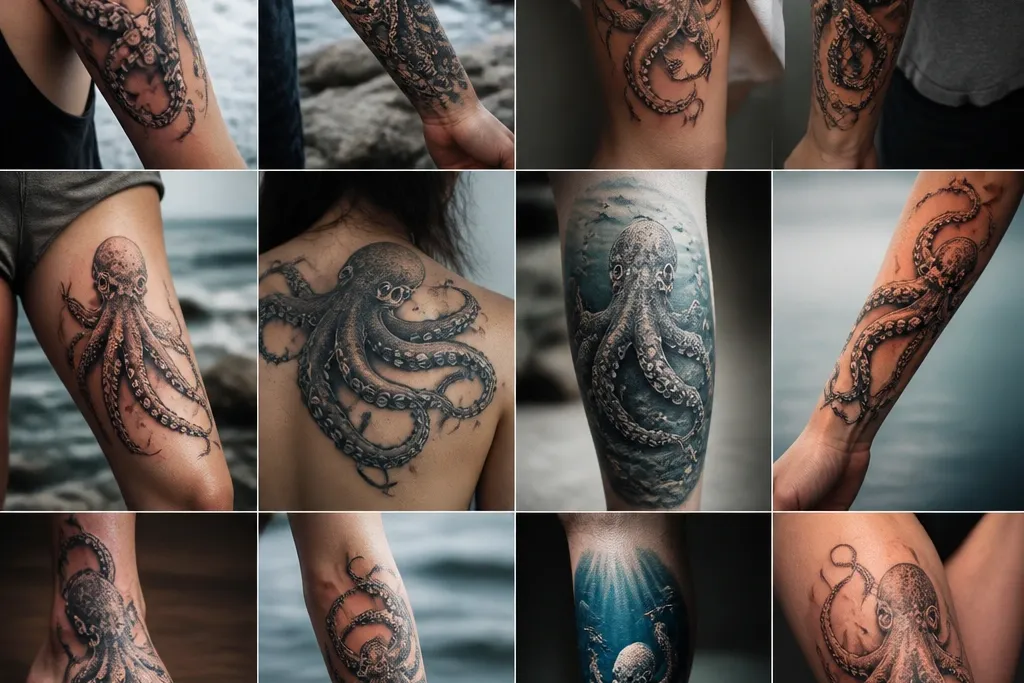
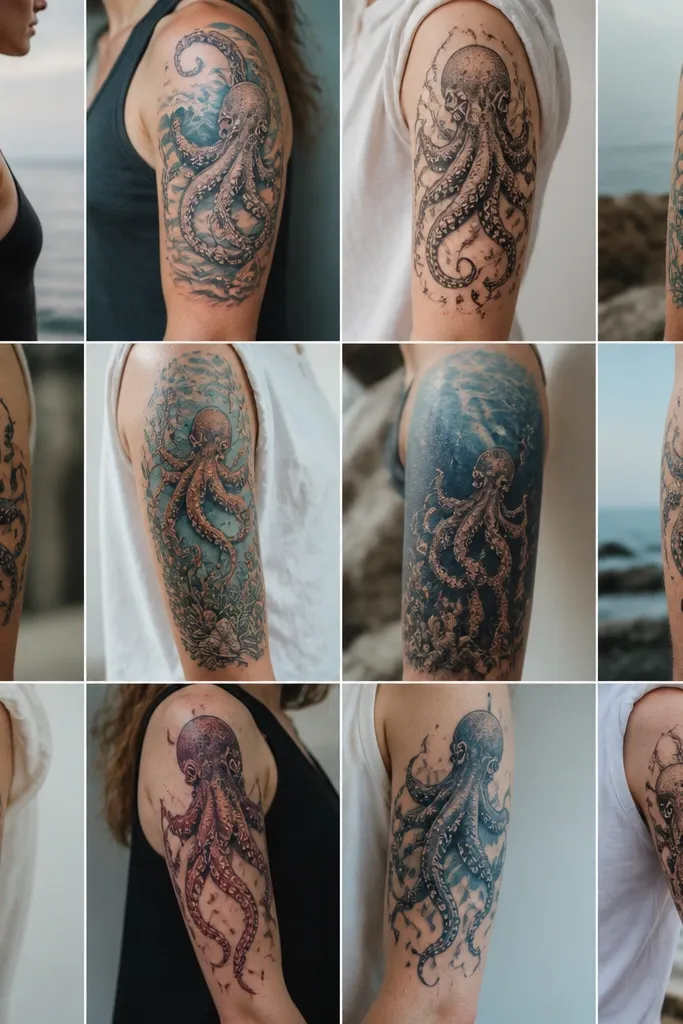
1. Wrist-to-Elbow Wrap Octopus With Bubble Trail
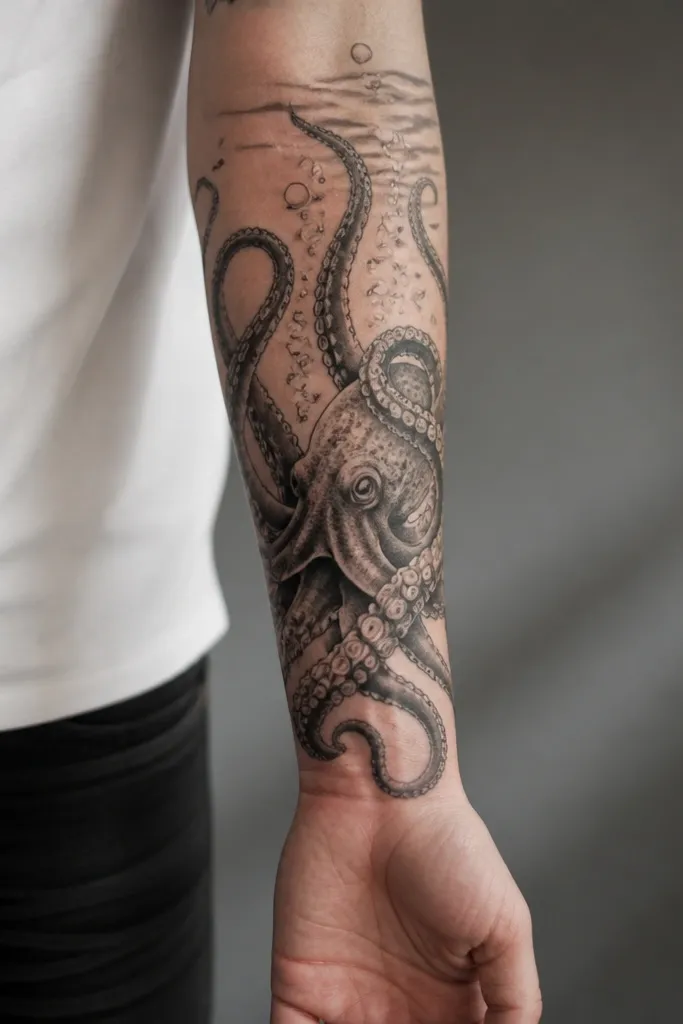
This layout reads like motion because the tentacles twist as they climb, and the bubbles give the eye a steady path. The suction cups are shaded with soft gray so they look dimensional instead of like dots. Ocean depth comes from a darker shadow band behind the tentacles and lighter gray highlights on the arm-facing edges.
Start the octopus head near the inner wrist crease, then angle one main tentacle to cross toward the outer forearm by mid-forearm. Keep bubble clusters in two sizes only: tiny pin bubbles and a few medium ones near the head. Finish with a thin wave ripple band just above the elbow crease so the sleeve feels "anchored."
Pro tipAsk your artist to stencil with your arm slightly bent, not straight, so the tentacle curve matches your real flex.
AvoidDon't scatter bubbles everywhere - if they're the same density across the whole arm, it looks busy and flat.
2. Outer Forearm Octopus Guarded by Seaweed Ribbons
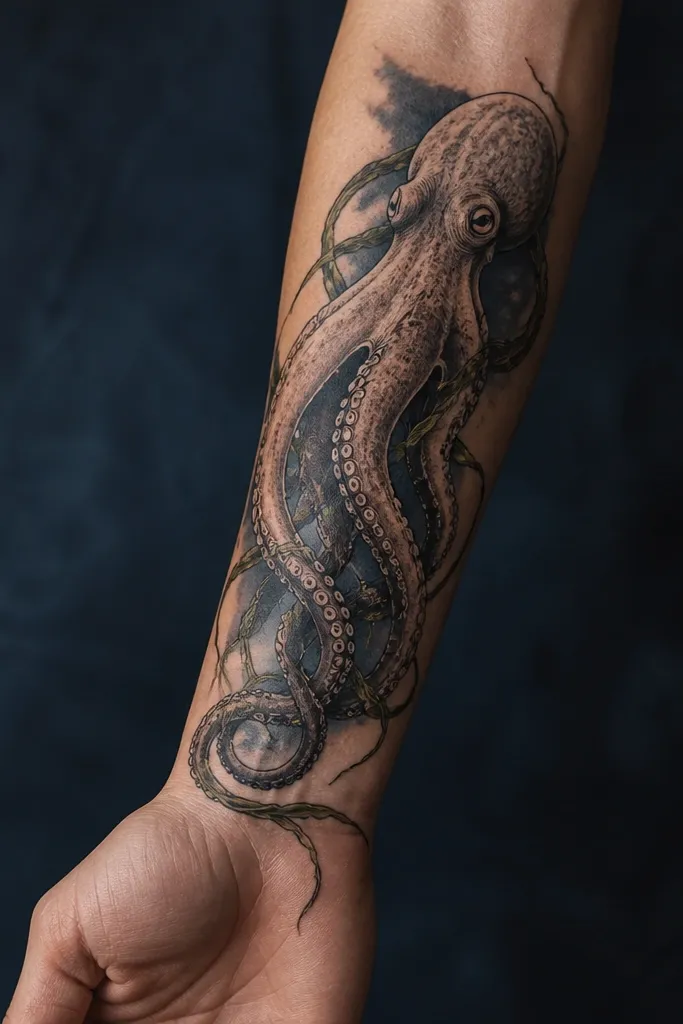
Seaweed ribbons frame the tentacles and prevent the design from looking like it's floating. The ribbons use lighter gray linework that thins toward the ends, which makes them look like they're moving in current. The navy shadow wash behind adds a water-column feel without drowning out the octopus.
Place the octopus body on the outer forearm centerline. Let seaweed strands enter from the sides, not from the top - it keeps them from crowding your main silhouette. Keep the ribbon lines fine and slightly uneven in thickness so they look hand-drawn, not machine-perfect.
Pro tipChoose a navy shade that's close to black, not bright blue; it ages better and stays readable.
AvoidAvoid thick seaweed lines that match the octopus outline weight - it turns into one blob.
3. Inner Forearm Octopus With Wave Band Collar
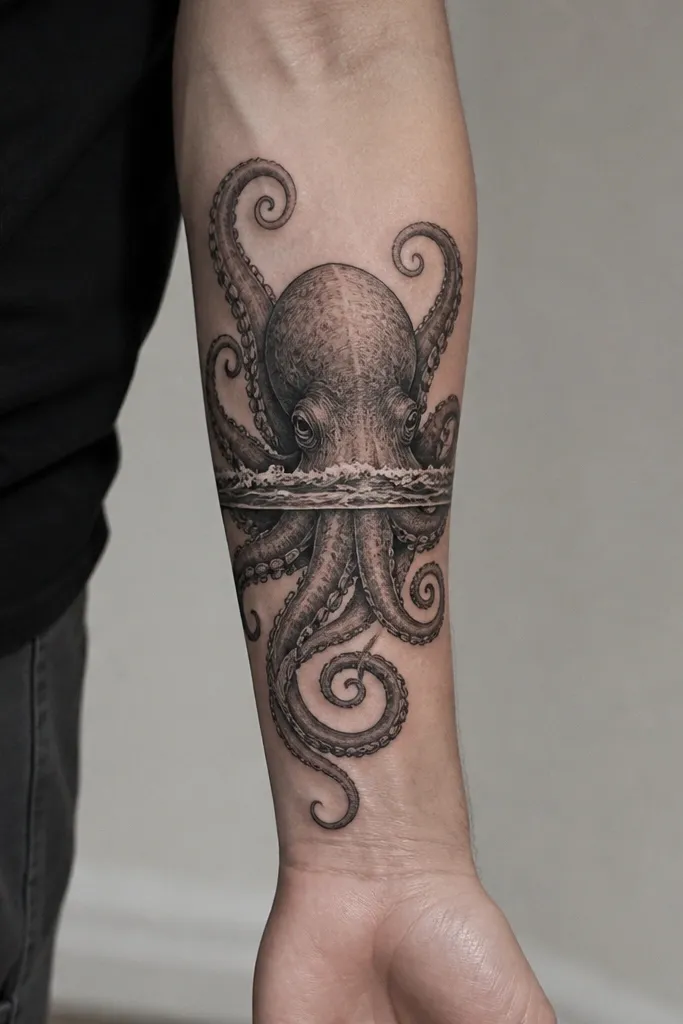
This placement is clean and wearable because the wave band creates a clear boundary. The octopus head sits closer to the inner arm where skin is smoother, and the tentacles fan outward so they don't stack awkwardly over the same spot. Foam lines on the wave band add texture without needing lots of extra background.
Position the wave band at mid-forearm, then have two tentacles rise above it and two fall below it. Make foam lines short and angled, following the curve of the band. Keep suction cups denser near the head and lighter toward the tentacle tips for a natural taper.
Pro tipIf you wear short sleeves often, keep the wave band slightly higher so it doesn't get stretched by wrist-to-hand motion.
AvoidDon't make the wave band too wide - if it covers most of the forearm, you lose the octopus shape.
4. Bicep Cap Octopus With Subtle Water Haze
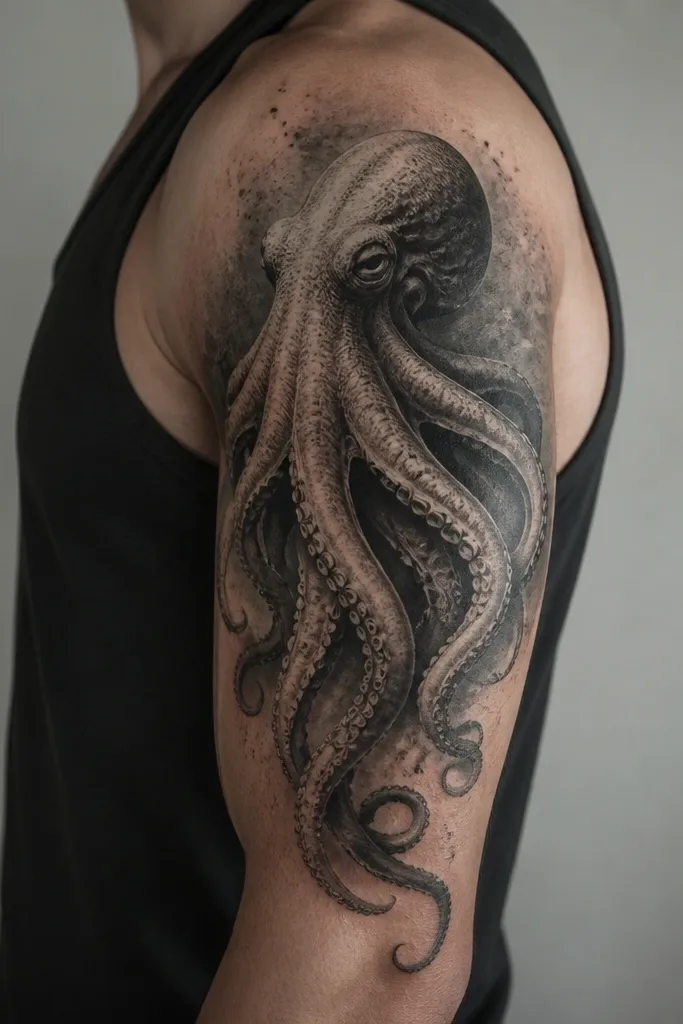
A bicep cap octopus looks strong because the head is in the "resting zone" where your arm looks good when relaxed. The water haze gives depth like mist, while the tentacles stay mostly in grayscale for crisp contrast. Tiny speckles act like distant particles in water, but they stay low density so they don't blur into gray mush.
Place the head near the bicep peak, then let tentacles taper down toward the outer upper arm. Use a tight radius around the head so it stays compact. Keep haze concentrated behind the head and fade it before it reaches the tentacle outlines.
Pro tipAsk for a test stencil on your bicep while flexed and while relaxed - the tentacle direction changes how the tattoo reads.
AvoidAvoid heavy full-shading across the entire bicep - it makes the octopus flatten when the arm flexes.
5. Forearm Octopus Skeleton Style With Ink-Black Tentacles
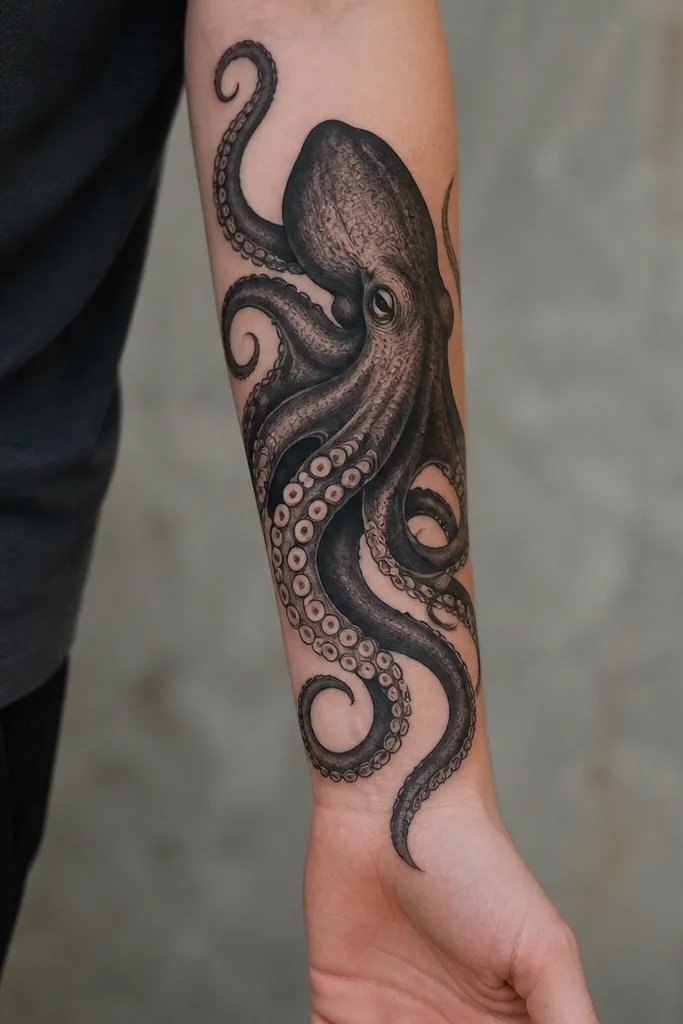
Skeleton-style octopus work makes the tattoo look graphic and high-contrast. Negative space highlights keep it from turning into a gray fog. The suction cups look crisp because the darkest areas are reserved for the tentacle ridges and sucker rims.
Outline the tentacles thick, then shade inside with gray only along the inner curve. Leave small highlight gaps where skin would catch light. Keep the ocean vibe minimal - a thin ripple line or two is enough so it stays readable at arm distance.
Pro tipIf you want this style, do it on the outer forearm where contrast looks best in natural light.
AvoidSkip super tiny micro-shading inside the suckers; it turns into a gray blur.
6. Octopus and Lanternfish Pair With Tiny Bioluminescent Dots
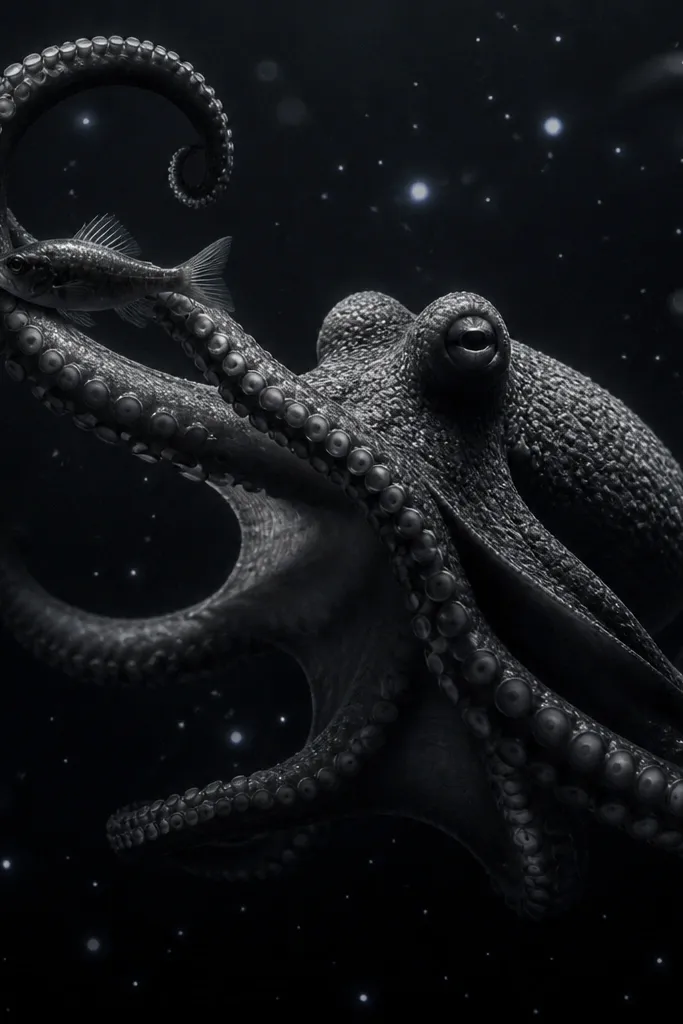
This is a "story" placement that still reads fast. The lanternfish gives you a clear secondary focal point, and the tiny dot highlights mimic light in water. The octopus remains the main subject with clean linework; the dots are sparse so they stay sharp after healing.
Put the octopus body on the inner forearm and place the lanternfish on the outer side of the same forearm so it shows when you rotate your wrist. Use a few larger dot bursts around the fish, then stop. Keep dot size consistent - one dot scale only - so it doesn't look like random specks.
Pro tipAsk your artist to use dotwork only in the background, not inside the tentacle shadows, so the tentacle depth stays smooth.
AvoidDon't add a full dotted sky - it makes the whole tattoo look dirty.
7. Octopus Tentacle Spiral Down the Inner Arm
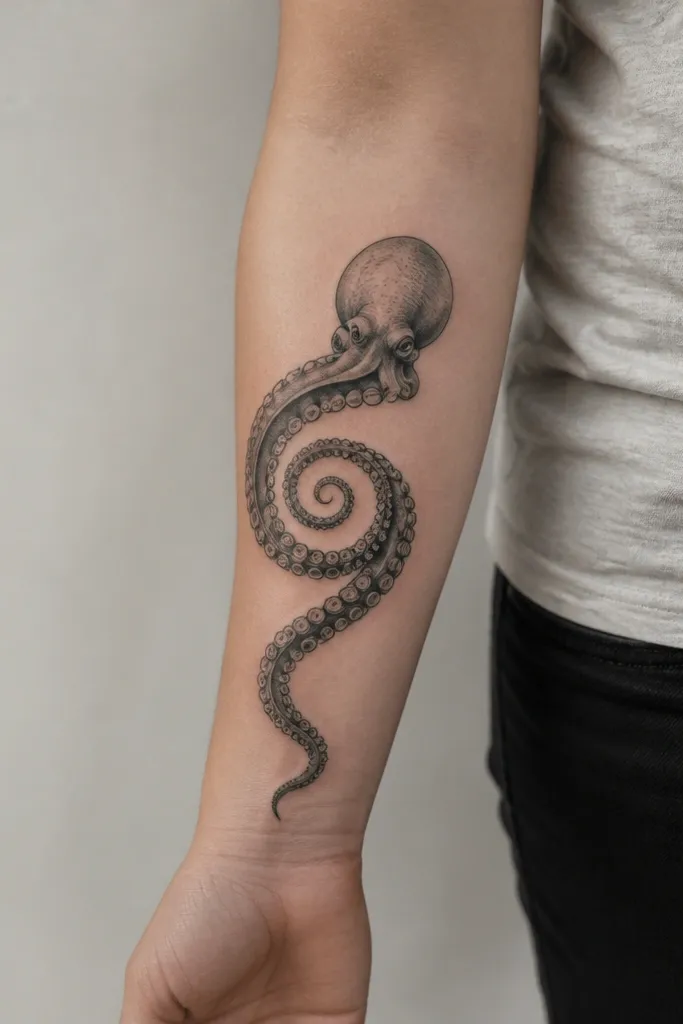
A spiral layout flatters the inner arm because it follows how skin stretches along the curve. The single tentacle makes the tattoo feel intentional and clean, not crowded. Suction cups are shaded with gray half-moons so they pop without needing heavy color.
Keep the head small, about 1.5 to 2 inches wide on the stencil, so it doesn't steal space from the spiral. Space suction cups evenly, but taper their size downward - bigger near the head, smaller near the wrist. Add one thin ripple line at the base to suggest water without filling the whole area.
Pro tipBring a photo of your forearm when you reach for your phone; that exact angle helps place the spiral correctly.
AvoidAvoid multiple tentacles competing in the same spiral lane - it looks like tangled lines.
8. Octopus Overlapping Wavelets With Negative-Space Foam
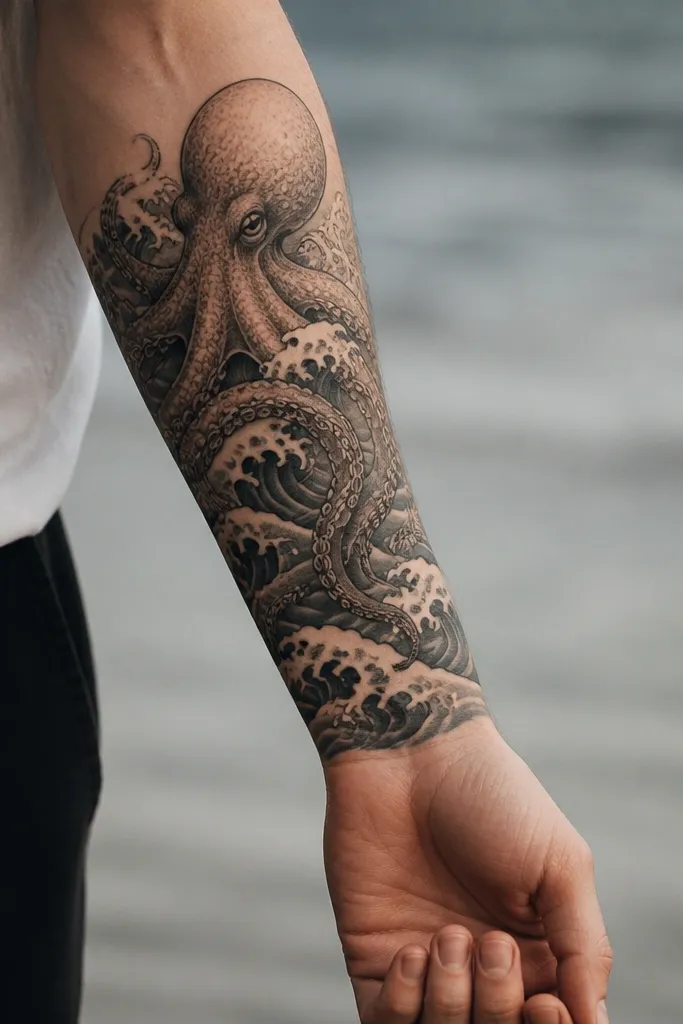
Negative-space foam looks crisp because it uses your skin tone as the highlight. Layered wavelets give structure, so the tentacles don't float in the middle of the arm. The octopus is shaded in gray only where the tentacles curve inward, which keeps the lines clean.
Draw three wave layers behind the tentacles, each thinner than the last. Place foam cutouts along the top edge of each wave layer, not the whole wave. Keep suction cups solid black rims with gray centers for depth.
Pro tipIf you tan or get sun, this style still looks good because negative space keeps contrast even after fading.
AvoidDon't overfill the foam with tiny dots - it defeats the point of using skin as the foam highlight.
9. Teal Ink Water Haze Octopus on the Outer Bicep
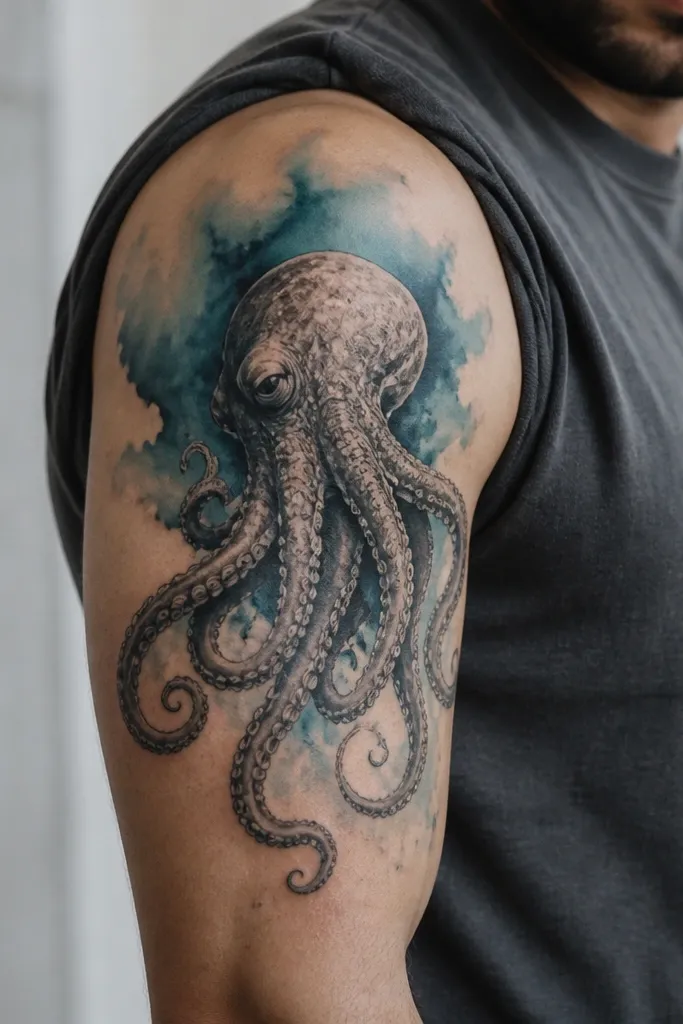
Teal haze gives ocean vibes fast without turning the tattoo into a cartoon. The trick is keeping the teal as a fade behind the main silhouette, not inside the tentacles. Navy edging makes the teal look like it has depth, like water color layered over shadow.
Use teal in a tight oval behind the head and let it fade before reaching tentacle outlines. Keep tentacle shading gray so the tattoo stays readable. Add one small coral-red dot on a sucker rim or the side of the head so the color doesn't feel random.
Pro tipAsk for color packing with a soft fade technique, not a solid fill - solid teal can heal patchy on bumpy skin.
AvoidAvoid bright cyan everywhere; it can look neon and muddy as it ages.
10. Elbow Crook Octopus With Two Tentacles Crossing
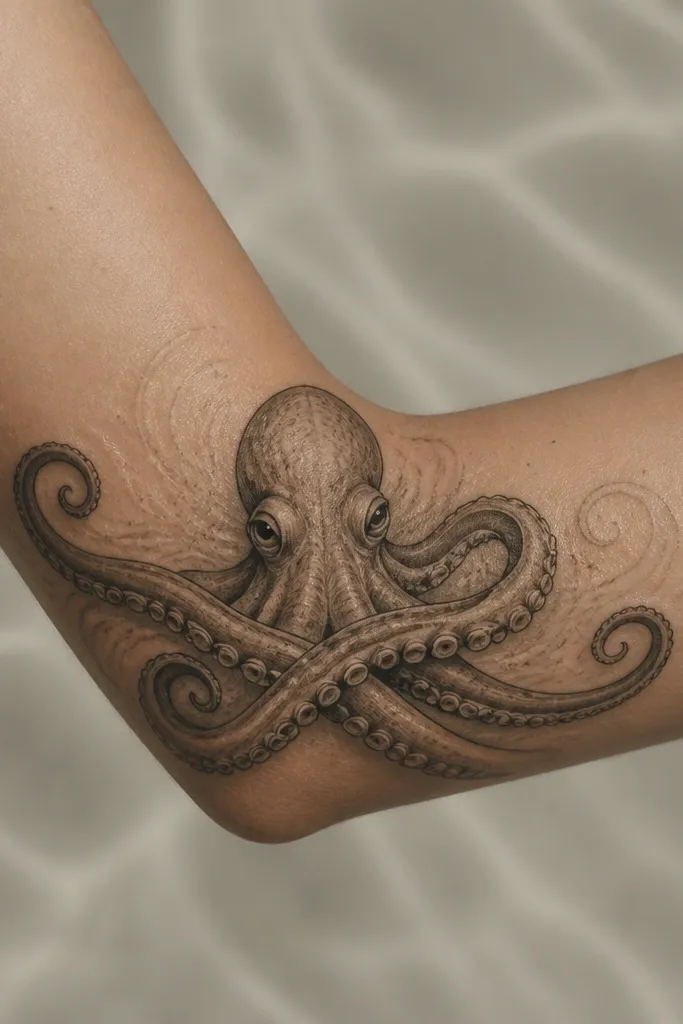
The elbow crook is a strong spot because it naturally frames the tattoo like a bowl. Crossing tentacles create a 3D overlap effect, and the crook placement makes the lines look intentional even when your elbow bends. Faint ripple marks keep it ocean-themed without adding extra elements that could distort.
Center the octopus head so it sits just above the crease, then send one tentacle down the inner forearm and the other down the outer forearm. Keep the crossing area at mid-elbow where skin stretches less than the exact crease. Use fewer foam details here because the elbow shape already adds texture.
Pro tipPlan healing products for the elbow - it gets rubbed by clothing more than other arm areas.
AvoidDon't put fine text or tiny seaweed sprigs at the exact elbow crease - they blur faster.
11. Octopus With Shell Scarab and Seafoam Frame
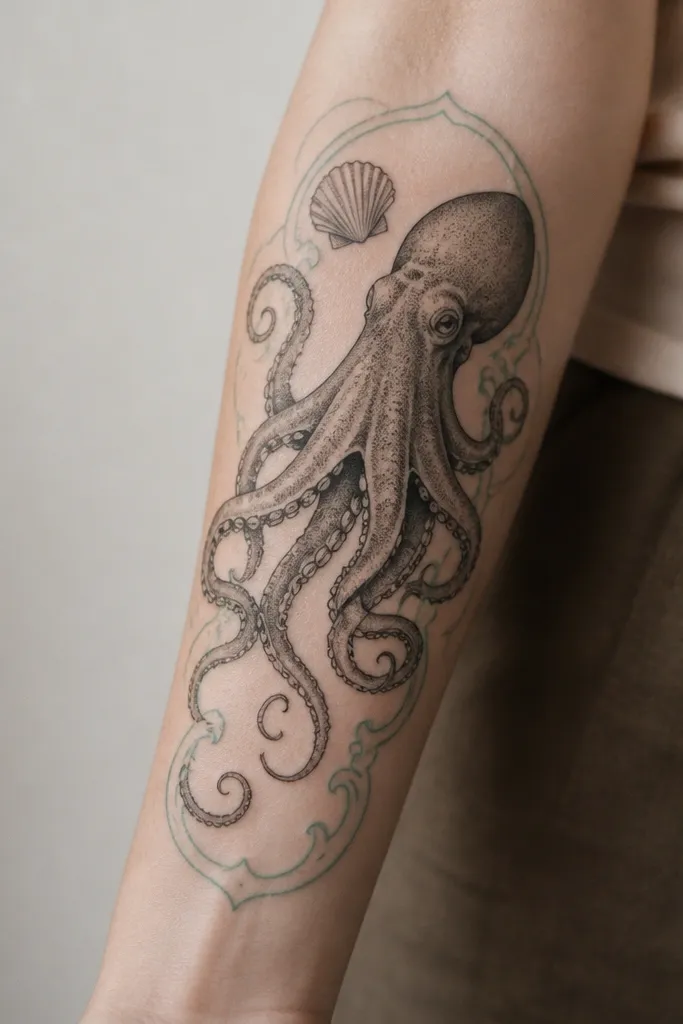
This one feels more "ocean artifact" than plain ocean. The shell shape gives you a focal anchor, and the seafoam frame makes the whole piece look finished, like it belongs in one composition. The tentacles stay clean and bold so the frame doesn't overwhelm the octopus.
Place the shell near the inner side of the head so it reads even when you rotate your arm. Draw the frame as one continuous curved band around the octopus, leaving a small gap for negative space. Keep the frame line weight slightly thinner than the octopus outline.
Pro tipIf you want this style, keep the shell minimal - one shaded curve and one highlight edge.
AvoidAvoid adding lots of tiny background artifacts; the frame needs breathing room.
12. Octopus and Manta Ray Shadow on Sleeve Side
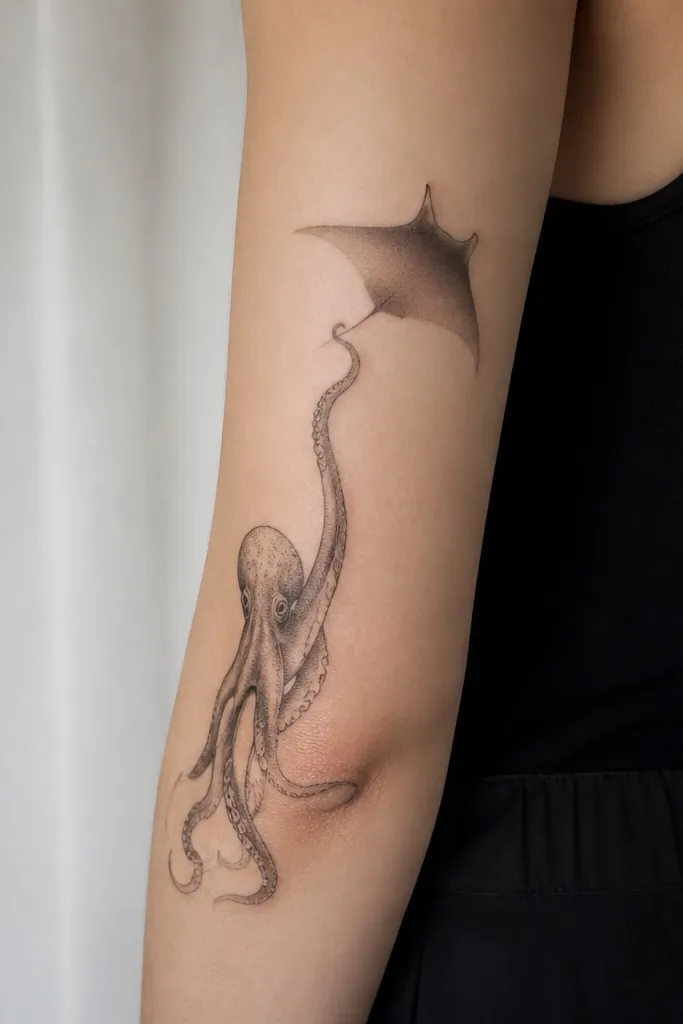
The manta ray silhouette makes the ocean feel bigger than your arm. The soft gray gradient behind the manta keeps it from competing with the octopus's crisp suckers. This arrangement is great if you want your tattoo to look like it continues beyond the edges - the manta's wings guide your eye.
Place the octopus head on the mid-outer forearm and let the manta silhouette sit higher, partly behind the tentacles. Use a gradient from darker gray near the tentacle contact point to lighter gray at the far edge. Keep bubbles minimal - one small bubble pair near the octopus head only.
Pro tipAsk for the manta ray to be slightly off-center so it doesn't look like a sticker placed behind the octopus.
AvoidDon't outline the manta ray in thick black; soft shadow reads more realistic and ages better.