

1. Classic Tiny Heart with 3 Flames and Halo Ring
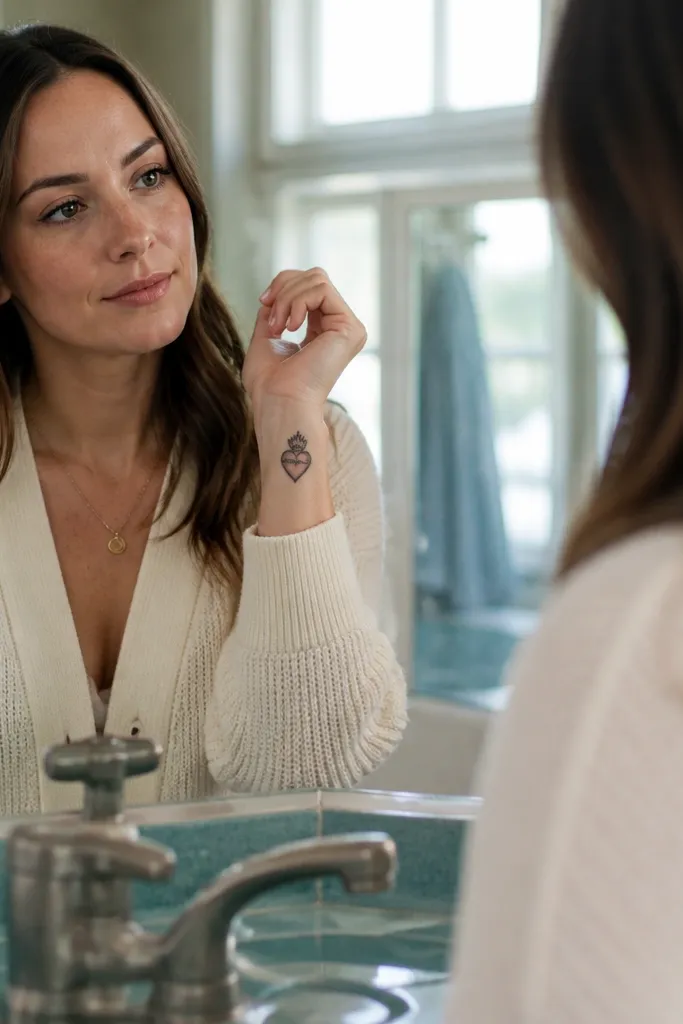
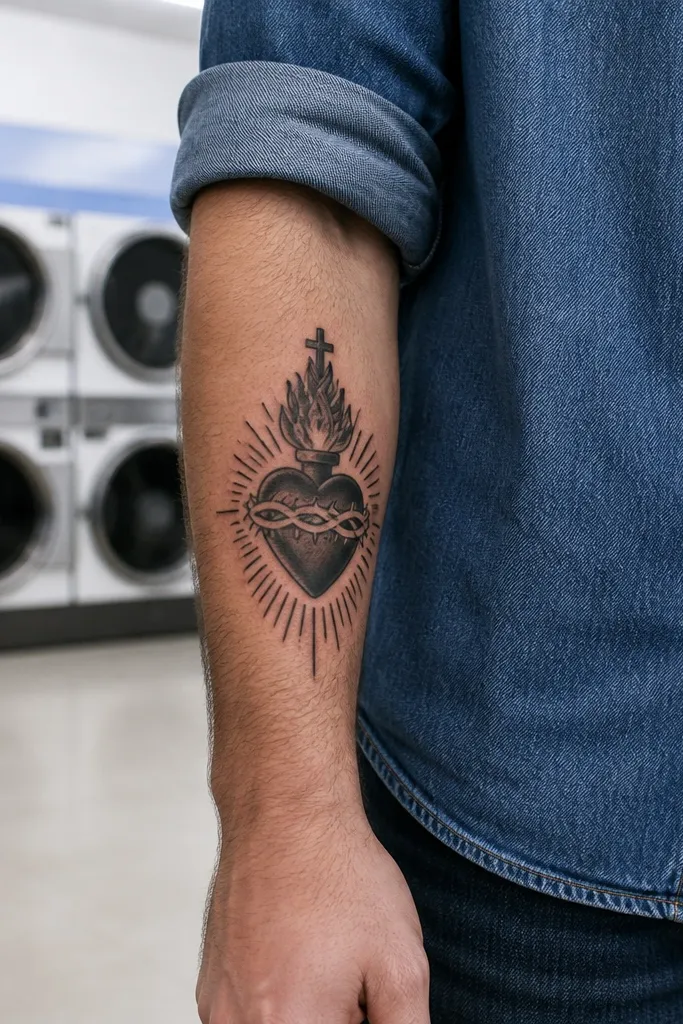
This design keeps the Sacred Heart recognizable using the essentials. The heart is drawn with a clean outline and minimal internal shading, so the shape stays legible even when the tattoo is small. Three flames sit above the heart — not a cluster — which reads as “traditional” without crowding the center. A single halo ring behind the heart adds the sacred context while keeping the overall look airy and photogenic.
Start by asking for a size around 5-6 cm tall on the wrist or inner forearm. Then choose linework that is consistent and not overly thick — you want a balanced outline with a light gray wash on the heart only. Keep rays out of this one; the halo ring does the work. Finally, plan placement where it won’t rub — avoid the watch band edge and tight bracelet contact. Aftercare is standard: wash gently, pat dry, and keep it out of direct sun for the first few weeks so the thin lines heal clean.
Editor's noteRequest a halo ring with a small gap so it doesn’t fuse into a solid black circle over time.
One warningDon’t add a lot of dot shading in the heart — it turns into texture soup at small sizes.
2. Sacred Heart on a Minimal Ribbon Banner
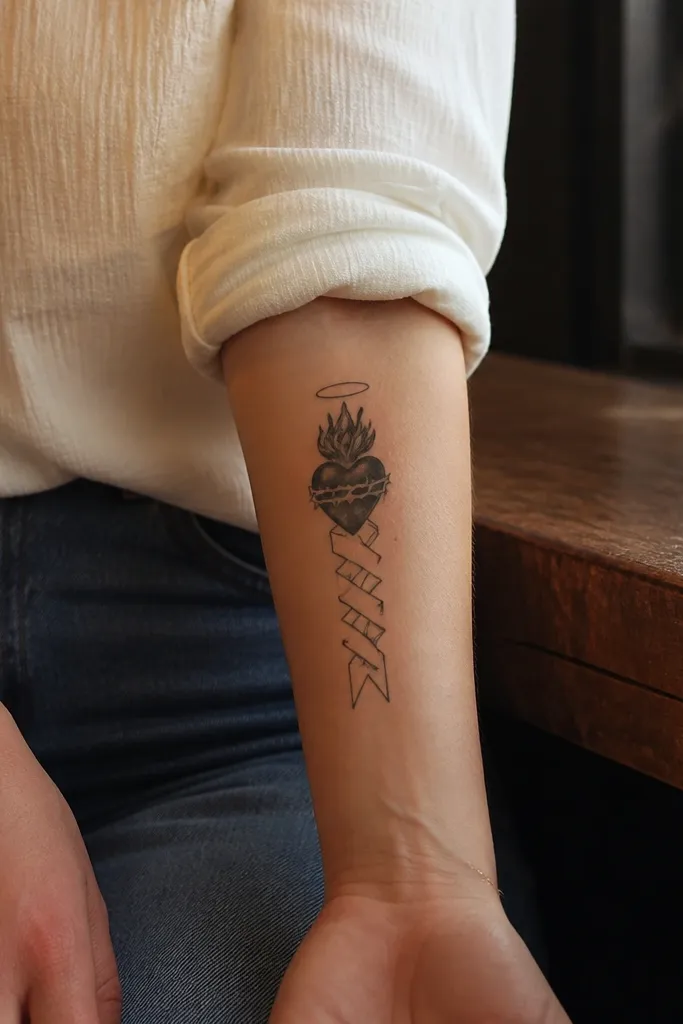
This one looks polished because the banner gives the tattoo a vertical frame. The heart stays small and focused, while the ribbon lines create structure without turning the piece into a busy illustration. Flames are kept to simple tips, and the ribbon is drawn with clean, V-shaped folds. It photographs well because the ribbon creates a clear silhouette, even when the lines are fine.
Start by placing it on the outer forearm or upper arm where the ribbon can sit flat. Then keep the ribbon text-free or use no letters at all — just folded banner lines. Ask for a light gray heart with a dark outline, and place three small flame points above the top. Finally, size it at about 5-7 cm tall so the banner folds stay crisp. Aftercare: use unscented moisturizer once the tattoo starts peeling, and avoid heavy friction from sleeves during the first week.
If you want lettering, keep it to a single short word and keep font size large enough to stay readable after healing.
Skip micro-lettering — it will blur and steal attention from the heart.
3. Halo Rays as Tiny Straight Lines
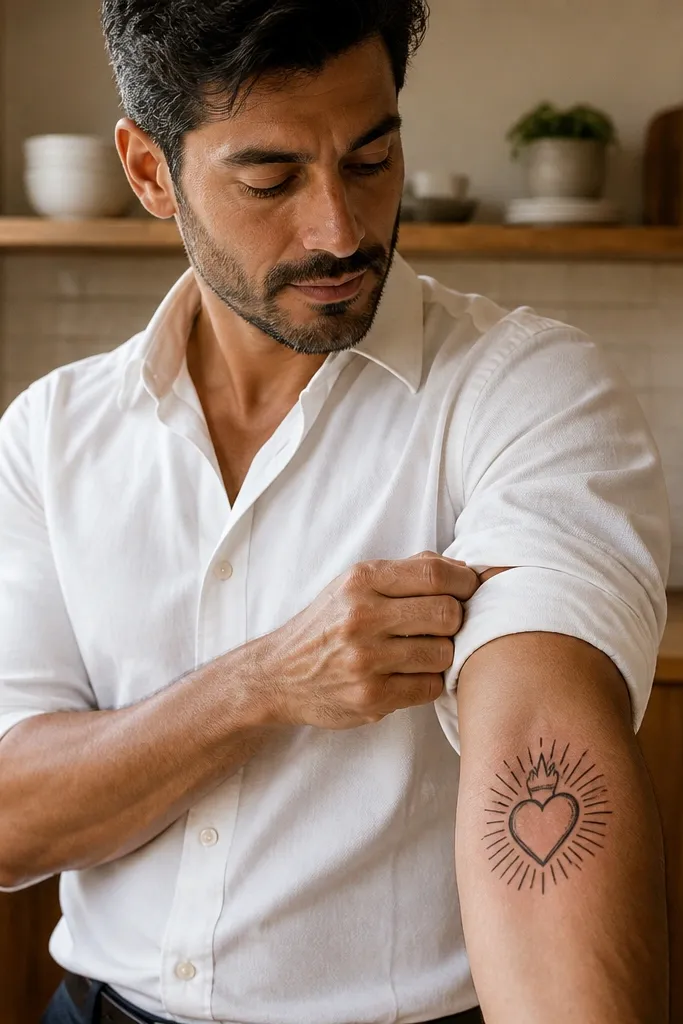
Instead of a full ornate background, this uses tiny straight rays that feel traditional but stay minimal. The halo ring anchors the center, and the short rays radiate outward like a clean crown. Because the rays are made from straight lines, they age better than curved swirls — they keep their direction and readability. The result is a Sacred Heart that looks crisp in both bright and low light.
Start by choosing a placement on the collarbone or upper chest where the rays can spread without bending. Then keep the rays to 8-12 short lines, each with the same weight as the heart outline. Use a light gray wash inside the heart and a thin darker line for the flame edges. Finally, keep the overall height around 4.5-6 cm so the rays don’t crowd each other. During healing, protect from sun and avoid tight bras or straps that press on the fine rays.
Ask your artist to draw the ray spacing first in stencil — it should look balanced, not dense.
Don’t use long rays that reach far beyond the halo; they’ll blur into a halo “smear.”
4. Small Sacred Heart with Cross Accent
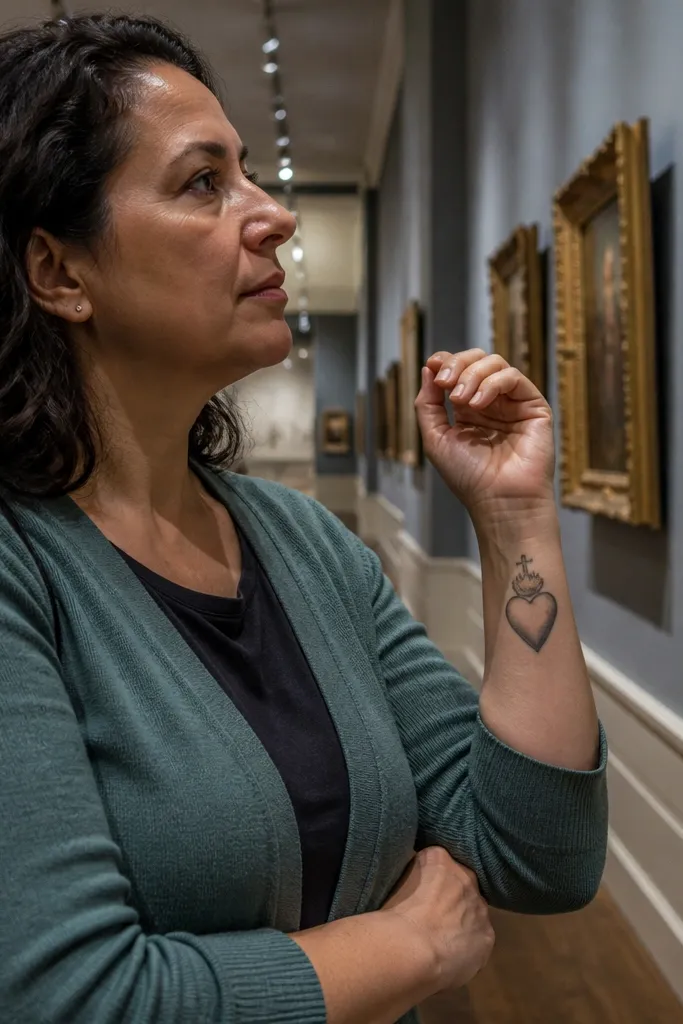
This design gives you the religious cue without needing heavy shading or a full scene. The heart stays the main subject, while a small cross sits low enough to frame the composition. It reads as traditional because the cross is simple and clear, not ornamental. The tattoo looks especially good on the inner forearm or upper arm because the cross adds a strong vertical line that holds the eye.
Start with a vertical layout at about 5-6.5 cm tall. Then place the cross directly beneath the heart with consistent line weight — don’t make it thicker than the heart outline. Use three small flames above, and keep the heart interior mostly white with only a light gray gradient. Finally, request minimal negative space around the cross so it doesn’t look tangled with the heart. Aftercare matters: keep it moisturized once it peels and avoid soaking for the first couple of weeks.
Choose a cross with clean arms and sharp corners; rounded crosses soften the silhouette.
Avoid dense shading behind the heart — it makes the cross disappear as the tattoo fades.
5. Minimal Sacred Heart with Single Flame Tail
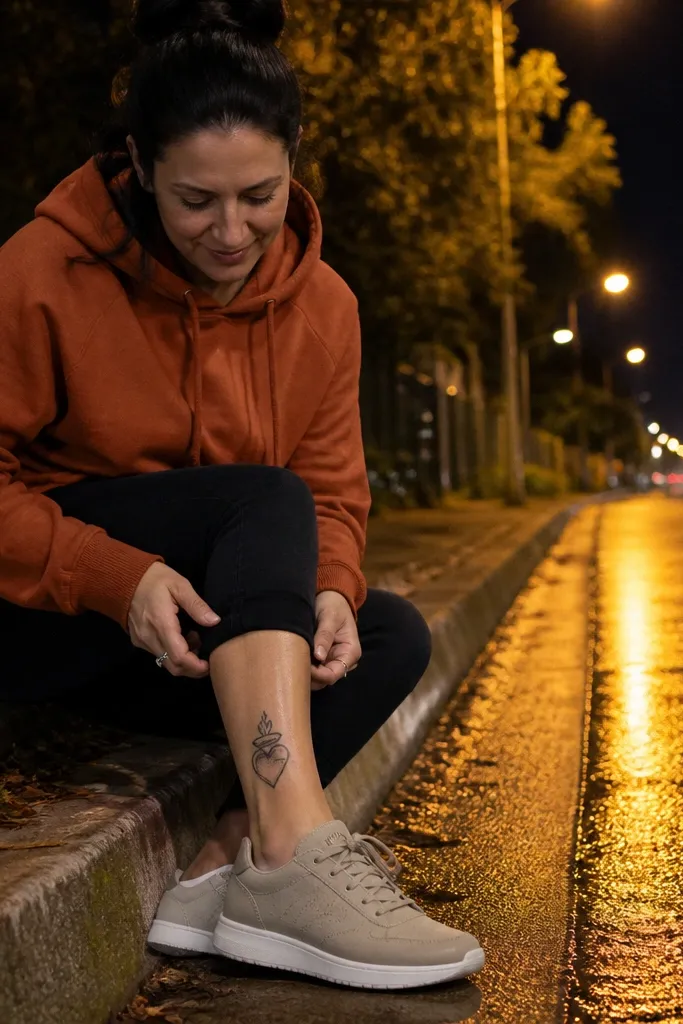
This is a clever minimalist variation: one flame tip instead of three. It still signals Sacred Heart because the heart shape and halo do the heavy lifting. The single flame makes the tattoo look delicate and “designed,” not like a cut-down version of a bigger piece. It’s also great for placements where multiple flames would crowd, like the side of the wrist.
Start by placing it on the side of the wrist or inner ankle where a single accent reads cleanly. Then ask for a halo ring or tiny rays behind the heart, but keep the halo small so it doesn’t dominate. Use a light gray wash inside the heart and define the flame with a thin outline and one internal highlight. Finally, size around 3.5-5 cm tall for maximum crispness. Healing: protect from friction, especially if it sits near a shoe or watch.
Editor's noteRequest the flame to have a slightly tapered tip — it keeps the “fire” look without thickening.
One warningDon’t add extra flames or spark dots; the whole point is clean negative space.
6. Traditional Sacred Heart with Small Rays in a Half-Circle
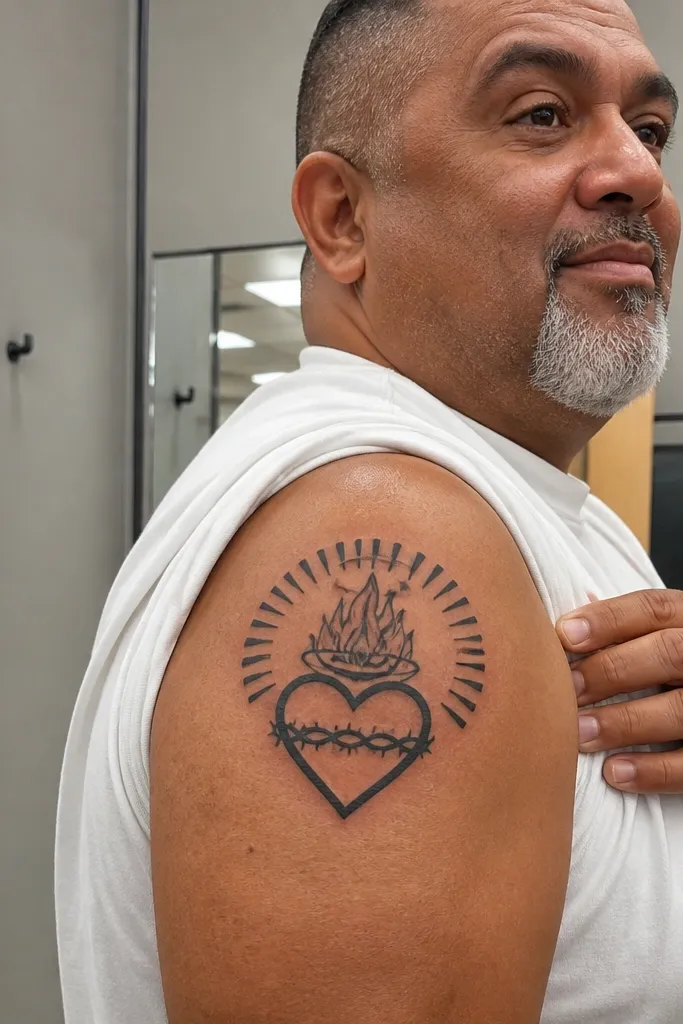
A half-circle ray fan looks traditional but stays contained. This layout is photogenic because the rays create a soft arc framing the heart without spreading across the skin. The heart outline stays the star, while the rays add motion. It’s a strong choice for shoulder and upper arm placements where you want a focal symbol that doesn’t go wide.
Start by marking placement so the half-circle arc sits symmetrical around the heart — usually on the upper arm front or shoulder. Then keep rays to 10-14 short lines, each ending at the same length. Use a light gray heart interior and keep the flames to three small tips. Finally, keep the piece about 6-7 cm tall so the arc doesn’t crowd the heart. Aftercare: apply moisturizer lightly and avoid picking any scabs — thin lines are fragile during the first week.
Editor's noteAsk for the arc to align with the curve of the arm so it looks intentional in motion.
One warningSkip full 360-degree rays — they make small tattoos look noisy.
7. Micro Sacred Heart with Thick Outline and Minimal Fill

This one uses a stronger outline to fight the “small tattoo blur” problem. The heart is still minimalist, but the bold outline keeps the shape crisp as it heals and fades. Tiny flames sit on top and a halo ring behind gives the sacred identity. It’s a good option when you want maximum readability from a distance, even with minimal detail.
Start with a size around 3-4.5 cm tall for best clarity. Then choose a line weight that is noticeably thicker than the rays you might add — or keep rays out entirely. Use minimal internal gray so the heart stays clean. Finally, place it on the upper outer arm or calf where skin texture and movement are manageable. Aftercare: sunscreen after healing is non-negotiable for bold outlines; thin lines fade faster under sun.
Ask the artist to show you a stencil preview on your skin so the outline doesn’t look too heavy.
Don’t combine thick outline with heavy black fill inside the heart — it turns into a dark patch.
8. Sacred Heart with Rose Petal Flame Accent
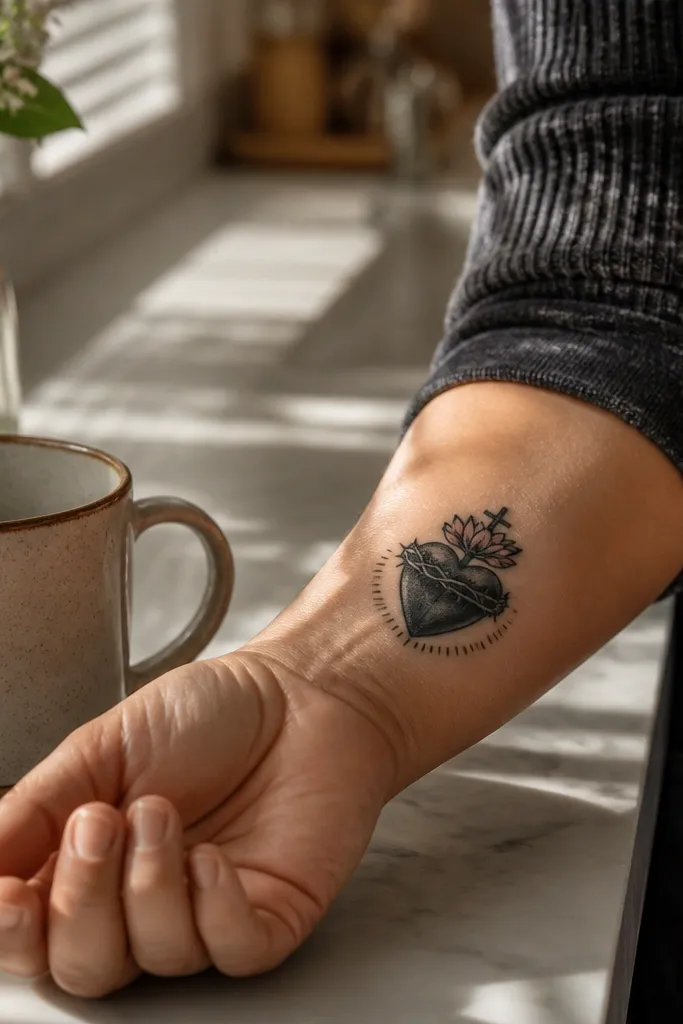
This design keeps the Sacred Heart layout but softens the flames into petal shapes. It reads traditional because the heart and halo are intact, while the petal flames make it look more romantic and aesthetic. The linework stays thin and clean, and the petal edges add visual interest without needing shading. It’s a great choice for wrists, forearms, and upper arm where you want something feminine but still icon-like.
Start by placing it on the inner forearm or ankle where the petal-like flames can curve naturally. Then ask for three petals above the heart, each with a single highlight line inside. Use a light gray wash on the heart only, leaving the rest white. Finally, keep the overall height 4.5-6 cm so the petal edges don’t merge. Healing tip: avoid tight socks or sleeves that rub the fine petal outlines during the first week.
Ask for flame tips that are symmetrical; crooked petals look like decoration, not sacred symbolism.
Skip extra florals around it — roses outside the flame area crowd the symbol.
9. Minimal Sacred Heart with Radiant Dashes
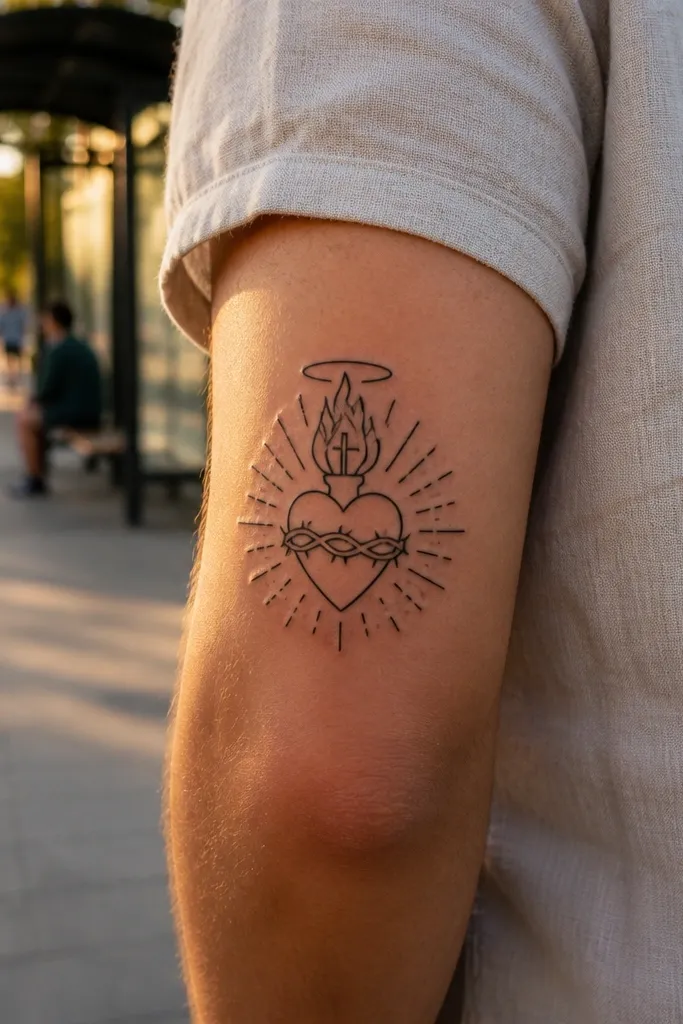
Dash rays are simple and graphic. They look like traditional radiance but avoid the clutter of full shading backgrounds. The heart stays outlined and mostly unfilled, so the tattoo reads as clean iconography. It photographs well on skin with texture because the dash rays create a consistent pattern. This is a strong choice if you want a minimalist look that still feels “complete.”
Start with an outline heart and halo ring behind it, placed on the outer forearm or side of the upper arm. Then create rays using 12-16 short dashes, all the same length and spacing. Flames should be three small pointed shapes with thin outlines. Finally, size around 5-7 cm tall so the dashes don’t blur into a haze. Aftercare: moisturize lightly and keep it out of direct heat; dash lines can look dull if the tattoo dries too fast.
Request slightly varied dash lengths by 1-2 mm for a natural radiance without losing symmetry.
Avoid curved rays or spirals — they turn into mush at this scale.
10. Sacred Heart with Hand-Drawn Style Outline
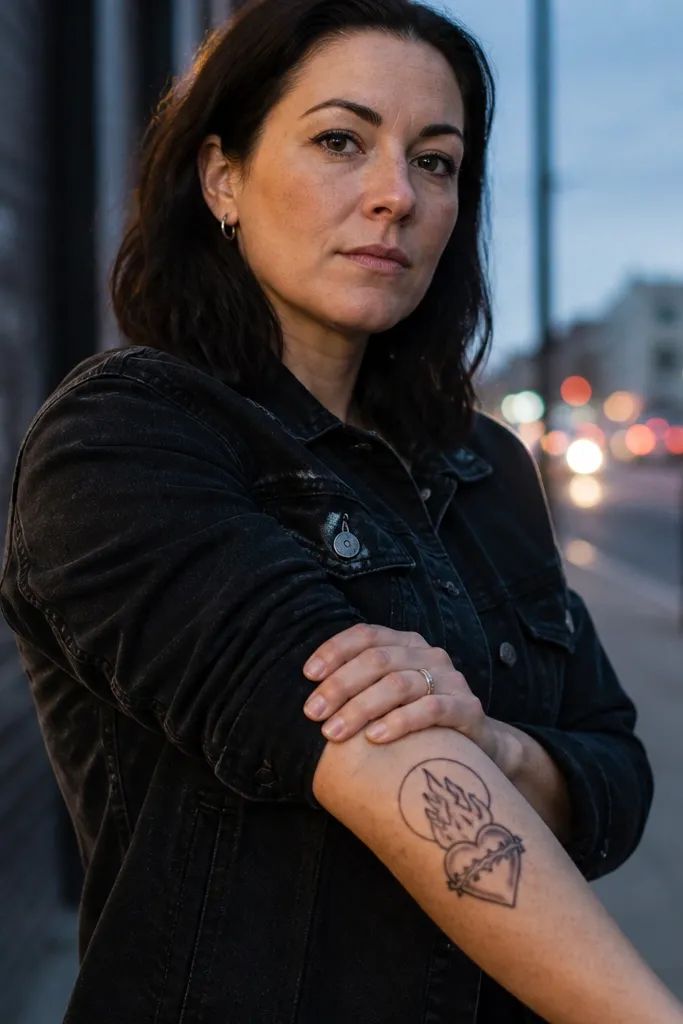
This is minimalist but not sterile. The heart outline has a slightly organic wobble, which makes it feel like traditional devotional art rather than clip-art. The halo ring is still clean, and the flames are simplified to three pointed shapes. Because the interior stays light, the design keeps its readability while the outline texture adds warmth. It suits people who want “traditional symbol” with a modern, hand-drawn vibe.
Start by asking your artist to draw the stencil first and keep the outline wobble subtle, not messy. Then keep the heart interior mostly unshaded with only a light gray gradient at the bottom. Use a thin halo ring behind and simple three flames above. Finally, size it 5-6 cm tall and place it on the forearm or upper arm. Aftercare: don’t over-moisturize; too much product can blur the look of delicate linework during healing.
Ask for the same line weight on all major strokes, then let the wobble happen within that weight.
Skip heavy gray fill — the hand-drawn outline loses contrast when the heart gets too dark.
11. Minimal Sacred Heart with Rays Only, No Halo
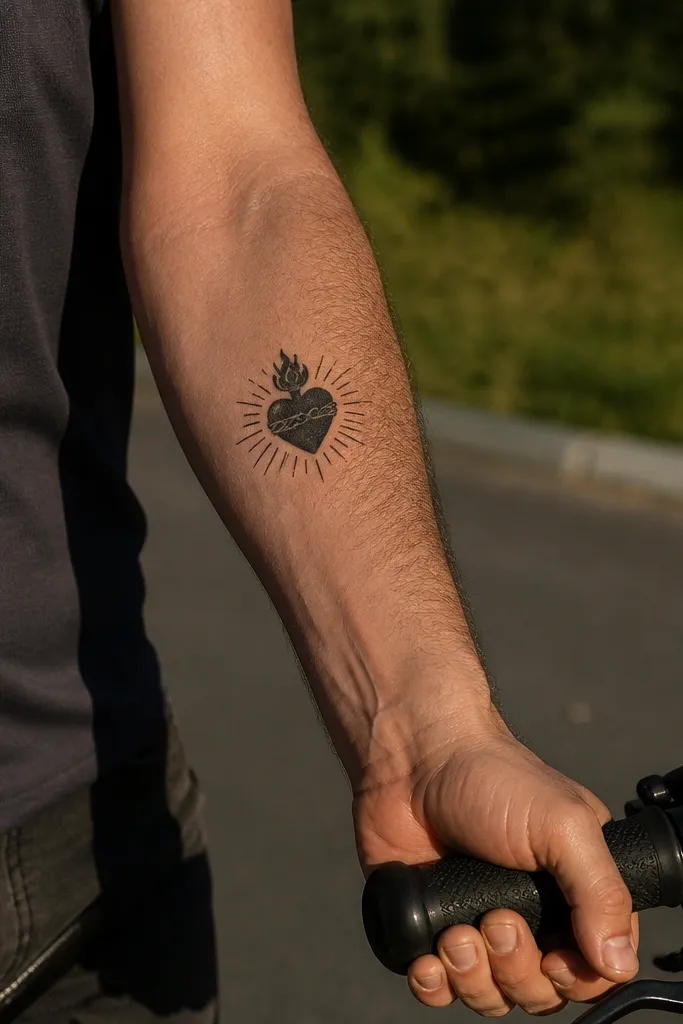
If you want fewer elements, this removes the halo ring and replaces it with rays. The heart and flames stay centered, and the rays give the sacred look without a full circle. It’s a clean, modern approach that still reads as Sacred Heart because the layout is correct. This works well for placements where a halo ring might look too round or too busy, like on the rib side or the back of the upper arm.
Start by placing the heart slightly higher than center so rays don’t crowd the lower area. Then draw 10-14 straight rays that fan upward around the heart, keeping the bottom rays shorter. Use three small flames with thin outlines and a light gray heart interior. Finally, size around 5-7 cm tall and keep the rays short so they don’t blur. Aftercare: keep the tattoo out of friction and follow standard wash-dry-moisturize timing.
Ask for ray tips to end crisp — no soft taper — so they stay readable over time.
Don’t add shading behind the heart; it makes the rays look muddy.
12. Sacred Heart Inside a Tiny Shield Frame
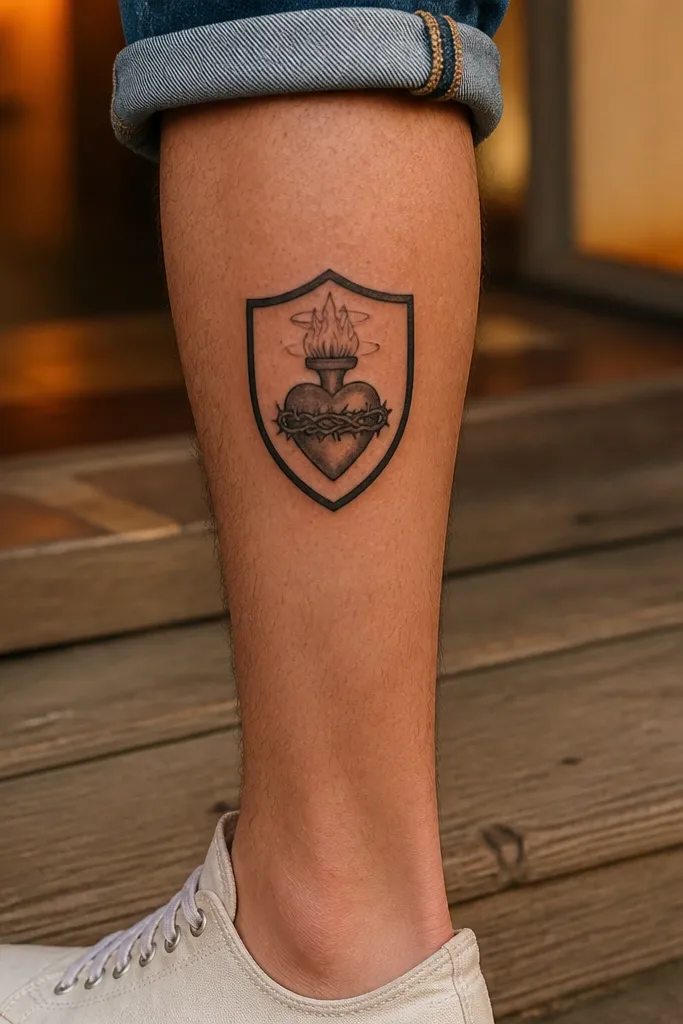
A tiny shield frame makes the tattoo feel traditional and emblem-like without going full illustration. The Sacred Heart sits in the center, and the shield outline creates a strong boundary that keeps the design looking intentional as it ages. Flames and halo are kept minimal so the emblem doesn’t turn into a cluttered crest. This is a great pick for forearm and upper arm where you want a symbol that looks “designed” in one glance.
Start by drawing a shield outline with clean, symmetrical curves and place the heart centered inside. Then keep the shield about 1-2 cm wider than the heart so the frame reads but doesn’t dominate. Use a small halo ring behind the heart and three simple flames on top. Finally, size around 6-8 cm tall so the shield stays sharp. Healing: shield outlines can dry tight — moisturize lightly once peeling starts to keep lines from looking brittle.
Ask for the shield line to be slightly thinner than the heart outline so the heart stays the focus.
Skip inner shield detailing like crosshatching; it breaks up readability.
13. Small Sacred Heart with Tiny Crown Above the Halo
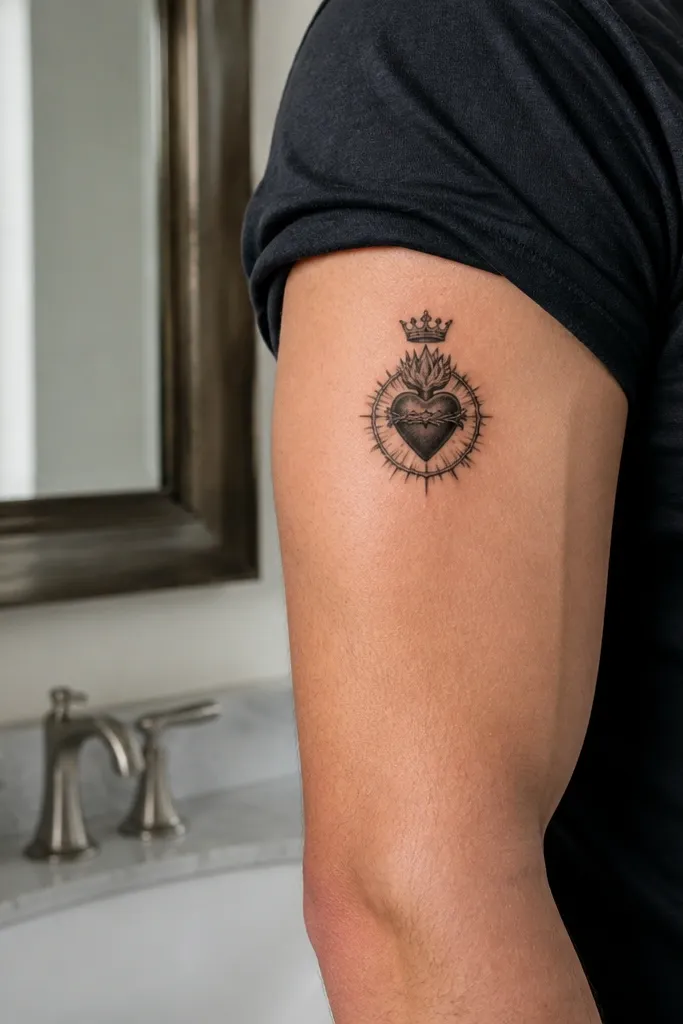
A small crown adds a clean, regal cue without changing the Sacred Heart identity. The crown sits above the halo ring, and the flames remain simple so the tattoo stays minimal. The crown has only a few points — no elaborate filigree — which keeps the lines from blending. It looks especially good on the upper arm or collarbone where vertical elements read nicely.
Start with a size around 4.5-6 cm tall so the crown points don’t crowd the flames. Then ask for a halo ring behind the heart, and place three flame tips directly above the heart. Draw the crown with 3-5 crisp points and thin connecting lines. Finally, place it on the collarbone front or upper inner arm and keep the crown aligned vertically with the heart. Aftercare: avoid stretching the area during early healing, especially on collarbone where skin shifts.
Editor's noteAsk for the crown lines to be the same weight as the heart outline, not lighter.
One warningDon’t add tiny jewels or dots on the crown; they blur fast.
14. Sacred Heart with Minimal Banner Below and No Text
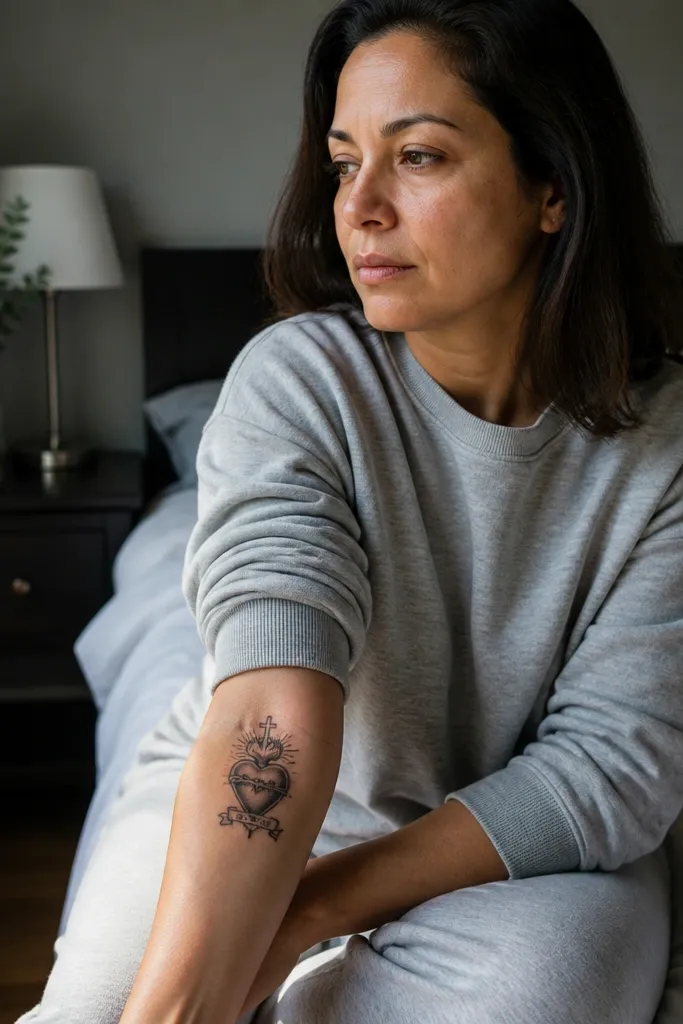
This design gives you the devotional composition without the risk of unreadable lettering. The banner below the heart has simple folds and two straight ends, so it looks like a classic traditional motif. The heart is outlined and lightly shaded, and the flames stay clean. Because there’s no text to blur, the tattoo stays crisp and aesthetic for longer.
Start by placing it on the inner forearm or upper arm, where the banner can sit straight. Then ask for a blank banner shape with two or three fold lines, keeping the folds thin. Use three flames above and a halo ring behind the heart. Finally, size around 5-7 cm tall, and keep the banner width about the same as the heart width plus 1 cm. Aftercare: keep the tattoo moisturized and avoid tight clothing rubbing the banner edges.
Editor's noteIf you want a motto later, plan a second tattoo after healing rather than forcing text into a tiny space.
One warningAvoid squeezing text into a small banner — it ruins the clean look.
15. Minimal Sacred Heart with Blue-Red Accent Wash
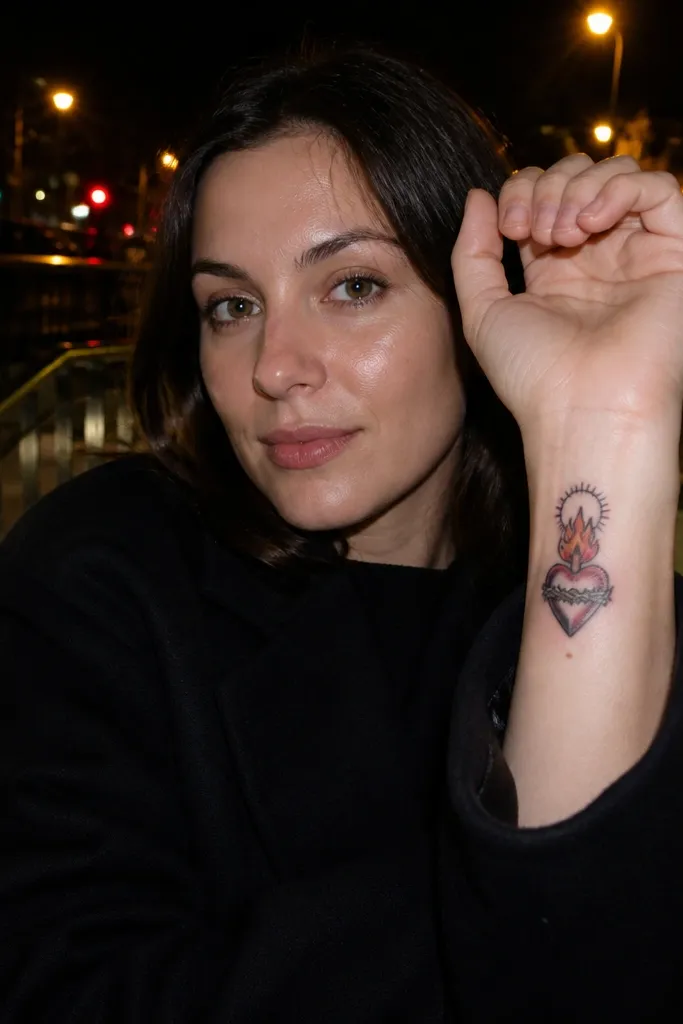
Color makes small tattoos pop when it’s controlled. This version uses a traditional-feeling accent: a light red wash at the top of the heart and a subtle blue-gray tone for depth, not full-color fill everywhere. The flames stay mostly black outline with minimal red-orange at the tips. The halo ring stays line-only so it doesn’t turn into a colored blob. It looks amazing in daylight because the color sits in the heart, where your eye expects it.
Start by picking a size around 5-6.5 cm tall and placing it where lighting is flattering, like the outer forearm. Then ask for color only in the heart top highlight and a small portion of the flame tips. Keep outlines black and avoid heavy color fill — you want negative space to remain. Finally, request a conservative red so it doesn’t fade into pink too fast. Aftercare: keep it out of sun hard during healing, because color accents fade faster than black linework.
Bring the artist a reference showing thin color placement inside the heart, not full color coverage.
Skip full red fill across the heart; it will look flat and muddy after a year.
16. Sacred Heart with Simple Crossed Knots at the Bottom
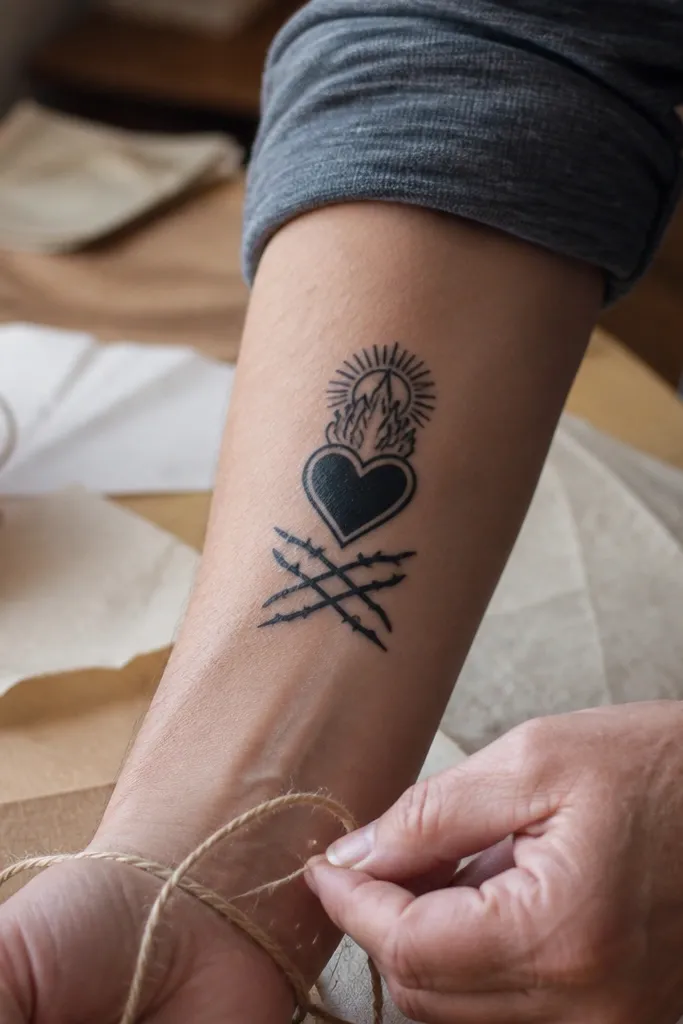
Crossed knot lines below the heart add a traditional devotional vibe without adding a full cross. The heart stays minimalist, and the knots create a symmetrical base that balances the flames above. It’s photogenic because the bottom element gives the design a strong “top-to-bottom” read. This is a great choice if you want something more graphic than a banner but still clearly Sacred Heart in silhouette.
Start by placing it on the front of the upper arm or outer forearm. Then draw the knots as two clean loops crossing, with only 2-3 line segments to keep it small and sharp. Place three flames above the heart and a halo ring behind. Finally, size around 5-7 cm tall so the knot lines don’t become too thin. Aftercare: keep the area protected from sweat and friction; knots and loops can trap irritation if you over-wash.
Editor's noteAsk for the knot lines to be slightly thicker than the rays you might add, so they don’t vanish.
One warningDon’t add extra decorative curls — they clutter the silhouette.
17. Sacred Heart with Minimal Rays and Small Heart Pulse Line
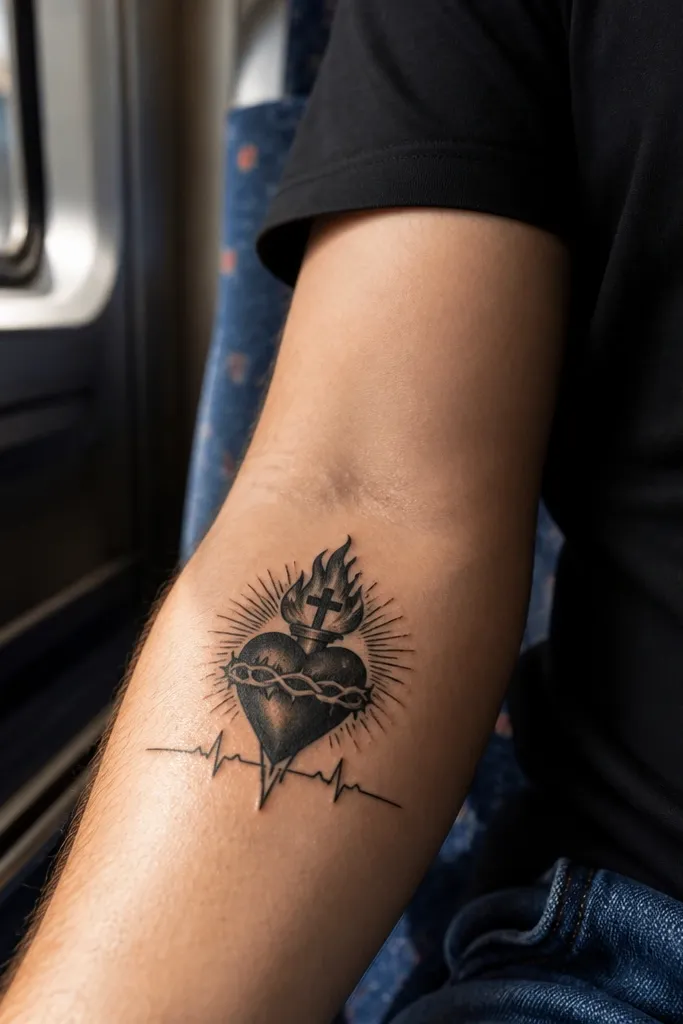
This is Sacred Heart with a subtle modern twist: a thin pulse line under the heart. It still reads traditional because the heart, flames, and halo rays are intact and centered. The pulse line adds a clean, graphic secondary element that looks good on forearms and ribs. It’s especially photogenic in flash photos because the pulse line creates a crisp contrast against skin.
Start by placing the tattoo on the forearm or rib side where the pulse line can run horizontally or slightly diagonal. Then draw the heart with a clean outline, three flames, and short ray lines behind. Add the pulse line below with one or two peaks, keeping it thin and centered. Finally, size around 6-8 cm tall so both elements are visible and not cramped. Aftercare: avoid stretching the rib area early healing; use loose clothing and keep it clean.
Editor's noteAsk for the pulse line to match the outline weight of the heart, not thinner.
One warningDon’t combine pulse line with tiny background dots; it makes the tattoo look busy.
18. Tiny Sacred Heart with Flame Tips Color Fade Only
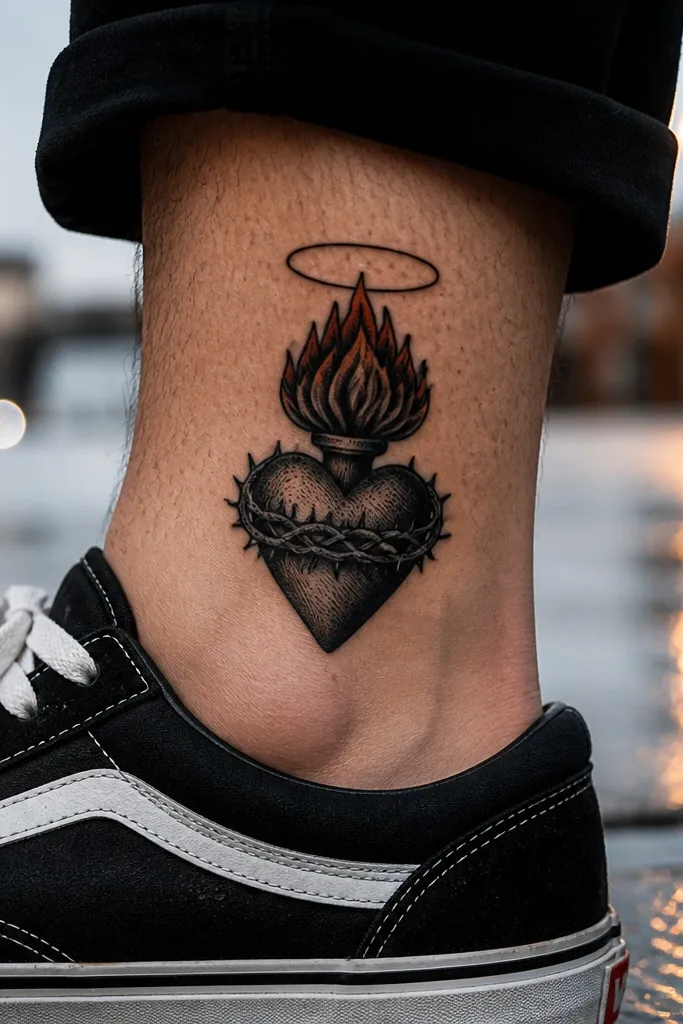
This keeps almost everything black and uses color only at the flame tips. That’s the smart way to do color in a small minimalist Sacred Heart Tattoo because it won’t disappear as quickly as full fills. The heart outline stays crisp, and the halo ring stays line-only, so the design remains readable. In photos, the tiny color pop makes the flames look alive without turning the tattoo into a color patch.
Start by picking a size around 4-5.5 cm tall and placing it on the inner forearm or ankle. Then ask for the heart outline and halo ring in black with minimal gray fill. For color, request a thin red-orange wash only at the very top edges of the flames, leaving the flame base black. Finally, keep the flames to three tips and avoid extra flame shapes. Aftercare: stay out of direct sun and use fragrance-free moisturizer so the color doesn’t heal patchy.
Ask the artist to test a small color stencil placement so the flame tips don’t bleed into the heart outline.
Avoid coloring the whole flame body — small color areas heal more cleanly.
19. Small Sacred Heart with Two Rays and Clean Negative Space
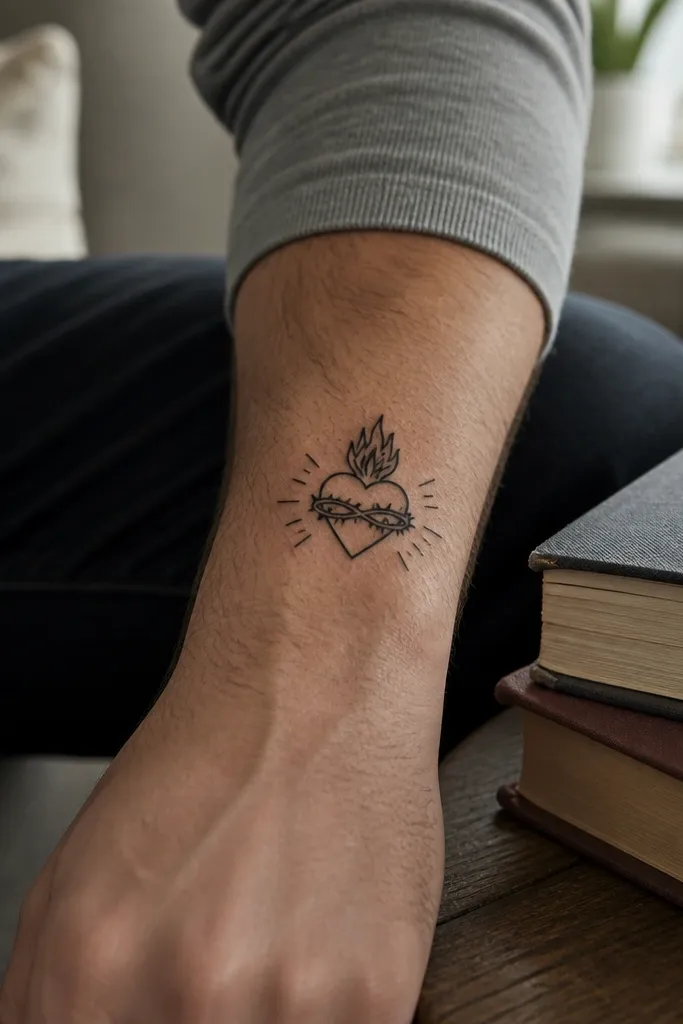
This is the minimalist version that still looks complete because it uses negative space like a design tool. Two rays on each side create symmetry without covering the skin behind the heart with marks. The heart outline is clean, the halo ring is optional but recommended, and the flames stay simple. It looks great on small placements like the wrist crease or inner ankle because the design doesn’t sprawl.
Start with a size around 3.5-5 cm tall and place it where you can keep it flat against the skin. Then draw the heart outline with a light gray gradient at the bottom and keep the top mostly white. Add three flame tips above and put two rays on each side — straight and short — leaving a big open center. Finally, decide on a halo ring that’s thin enough to avoid thickening as it heals. Aftercare: keep the tattoo dry early, then moisturize once peeling starts to keep the outline sharp.
Ask for rays to start from behind the halo, not from the heart outline edge.
Don’t add extra rays “to balance it” — the whole look is the open space.
20. Sacred Heart with Minimal Flame Garland
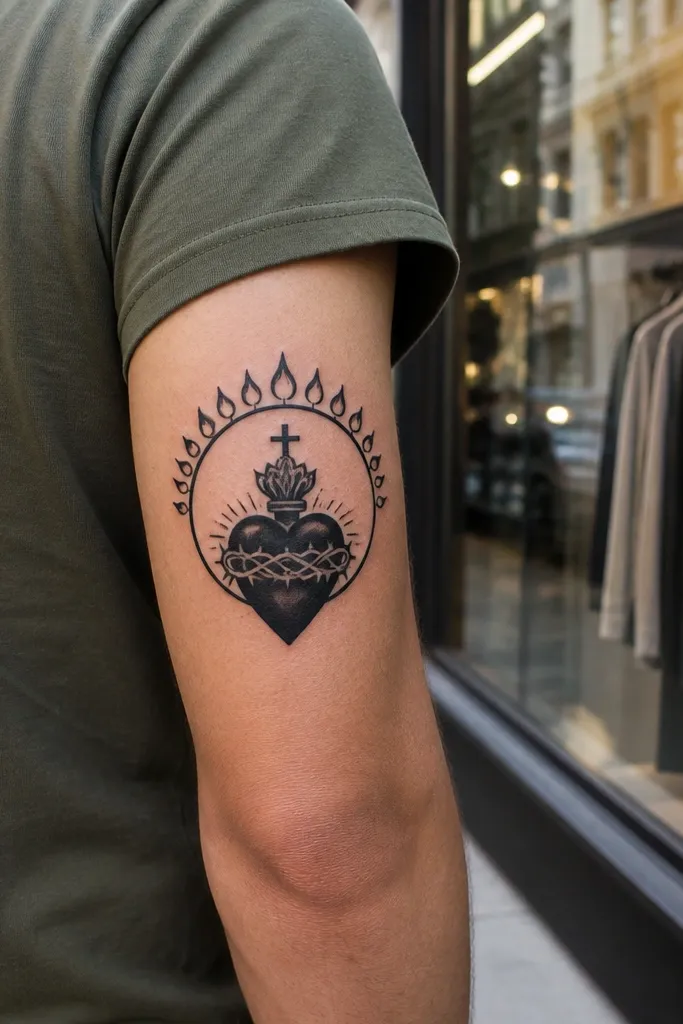
Instead of flames stacked directly above, this uses a thin garland arc. The heart stays central with a halo ring, and the flame garland curves around the top like a crown. It’s still traditional because the flame shapes are clear and the Sacred Heart layout is intact. The curved garland makes the tattoo feel softer and more decorative while staying minimal enough for small size.
Start by placing it on the upper arm front or outer forearm where an arc looks natural. Then draw the heart in the center, add a thin halo ring behind it, and create a garland arc with 5-6 simplified flame shapes. Keep each flame tip pointed and separated by clean skin. Finally, size around 6-7 cm tall so the arc stays readable and doesn’t flatten. Aftercare: protect from sweat buildup and avoid tight straps that press on the arc edges.
Ask for the garland arc to be slightly wider than the heart so it frames instead of crowds.
Skip shading behind the garland — let the arc be linework only.